



 | Bu fayl Vikianbarda yerləşir. Açıqlama səhifəsindəki məlumatlar aşağıda göstərilib. Vikianbar azad lisenziyalı media anbarıdır. Siz də töhfə verə bilərsiniz. |

Xülasə
| İzah |
English: 01.31.2014
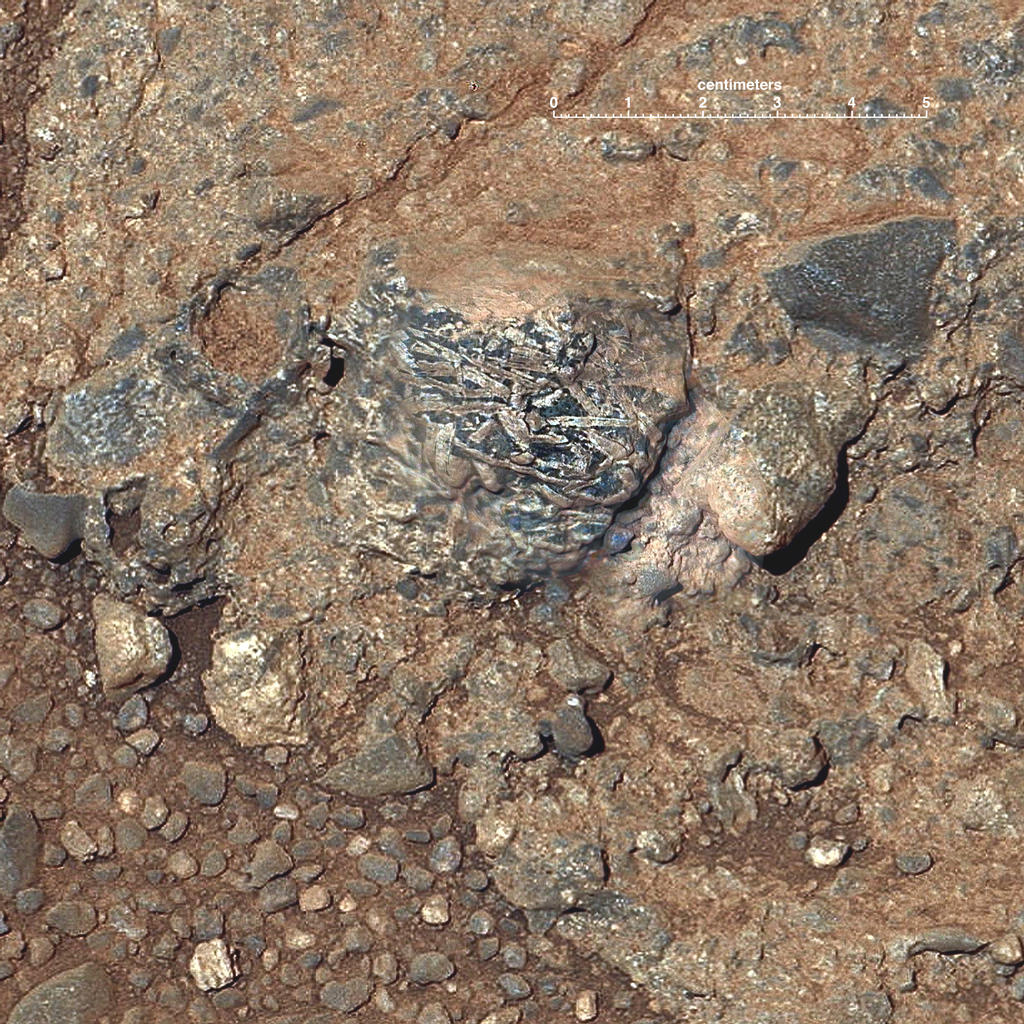
http://mars.jpl.nasa.gov/msl/multimedia/images/?ImageID=5950 Martian Rock 'Harrison' in Color, Showing Crystals (Annotated) This view of a Martian rock target called "Harrison" merges images from two cameras on NASA's Curiosity Mars rover to provide both color and microscopic detail. Curiosity inspected the rock's appearance and composition on the mission's 514th sol, or Martian day (Jan. 15, 2014). The Remote Micro-Imager (RMI) of the rover's Chemistry and Camera (ChemCam) instrument obtained the detail shown in the center of this view. The right-eye, telephoto-lens camera of the rover's Mast Camera (Mastcam) instrument obtained the color information and wider context. ChemCam's laser and spectrometers provided composition information. Harrison bears elongated, light-colored crystals in a darker matrix. Some of the crystals are about 0.4 inch (1 centimeter) in size. This annotated version of the image has a superimposed scale bar of 5 centimeters (about 2 inches). Based on composition information gathered from an array of ChemCam laser shots on Harrison, the elongated crystals are likely feldspars, and the matrix is pyroxene-dominated. This mineral association is typical of basaltic igneous rocks. The texture provides compelling evidence for igneous rocks at Gale Crater, where Curiosity is on a traverse to reach the lower slopes of Mount Sharp near the center of the crater.Polski: 31.01.2014
Kolorowe Zdjęcie Marsjańskiej Skały 'Harrison', Pokazującej Kryształy (Opatrzone Komentarzem) Widok marsjańskiej skały nazwanej "Harrison" powstał na skutek połączenia zdjęć z dwóch aparatów fotograficznych znajdujących się na pokładzie należącego do NASA marsjańskiego łazika Curiosity, dostarczając zarówno koloru, jak i mikroskopijnych szczegółów. Curiosity badał wygląd i skład skały w 514 marsjańskin dniu, lub sol, (15 stycznia 2014). Aparat do wykonywania zdalnych zdjęć makroang. Remote Micro-Imager (RMI) będący elementem instrumentu Chemia i Kamera ang. Chemistry and Camera (ChemCam) wykonał zdjęcie ze szczegółami widocznymi w centrum zdjęcia. Prawe oko kamery masztowej, aparat fotograficzny z teleobiektywem o ogniskowej 100 mm dostarczył informacji o kolorze oraz szerszy kontekst. Laser i spektrometr instrumentu ChemCam dostarczyły informacji o składzie chemicznym. Harrison zawiera wydłużone kryształy o jasnych kolorach ulokowane w macierzystej skale. Niektóre kryształy mają rozmiar około 1 centymetra. Wersja zdjęcia opatrzona adnotacją zawiera nałożoną skalę liniową o długości 5 centymetrów. Na podstawie informacji wynikających z serii promieni laserowych wystrzelonych przez intrument ChemCam w kierunku skały Harrison, wynika że, wydłużone kryształy są prawdopodobnie skaleniami, a skała macierzysta składa się z materiału gdzie dominującym materialem jest piroksen. Ta typowa asocjacja minerałów jest typowa dla bazaltowych skał magmowych. Struktura skały dostarcza nieodpartego dowodu, że skały w kraterze Gale to skały magmowe, gdzie Curiosity właśnie jest na szlaku którego celem są dolne zbocza Mount Sharp leżących blisko centrum krateru. . |
| Tarix | |
| Mənbə | http://mars.jpl.nasa.gov/msl/images/PIA17768-FigA_Harrison_m100_RMI-wb-scalebar-br2.jpg |
| Müəllif | NASA/JPL-Caltech/LANL/CNES/IRAP/LPGNantes/CNRS/IAS/MSSS |

Lisenziya

|
Bu faylın müəllif hüququ sahibi NASA/JPL-Caltech, hər kəsə hər hansı bir məqsəd üçün istifadə etməyə icazə verir, bir şərtlə ki, müəllif hüququ sahibinə düzgün istinad edilsin. Yenidən paylama, törəmə iş, kommersiya məqsədli istifadə və bütün digər istifadələrə icazə verilir. |
|
|
 
|
According to JPL's image use policy additional restriction is that no endorsement of any product or service by Caltech, JPL or NASA is claimed or implied.
Caltech's disclaimer: Caltech makes no representations or warranties with respect to ownership of copyrights in the images, and does not represent others who may claim to be authors or owners of copyright of any of the images, and makes no warranties as to the quality of the images. Caltech shall not be responsible for any loss or expenses resulting from the use of the images, and you release and hold Caltech harmless from all liability arising from such use. Usage on the English Wikipedia: On the English Wikipedia you can use the {{JPL Image}} template to display the copyright notice. (See w:Wikipedia:Using JPL images for details) |
Faylın tarixçəsi
Faylın əvvəlki versiyasını görmək üçün gün/tarix bölməsindəki tarixlərə klikləyin.
| Tarix/Vaxt | Miniatür | Ölçülər | İstifadəçi | Şərh | |
|---|---|---|---|---|---|
| hal-hazırkı | 20:13, 1 fevral 2014 | | 1.024 × 1.024 (323 KB) | Drbogdan | User created page with UploadWizard |
Faylın istifadəsi
Aşağıdakı səhifə bu faylı istifadə edir:
Faylın qlobal istifadəsi
Bu fayl aşağıdakı vikilərdə istifadə olunur:
- ast.wikipedia.org layihəsində istifadəsi
- ga.wikipedia.org layihəsində istifadəsi
- hy.wikipedia.org layihəsində istifadəsi
- pl.wikipedia.org layihəsində istifadəsi
- www.wikidata.org layihəsində istifadəsi
- zh.wikipedia.org layihəsində istifadəsi
