


 | Bu fayl Vikianbarda yerləşir. Açıqlama səhifəsindəki məlumatlar aşağıda göstərilib. Vikianbar azad lisenziyalı media anbarıdır. Siz də töhfə verə bilərsiniz. |

Xülasə
| İzah |
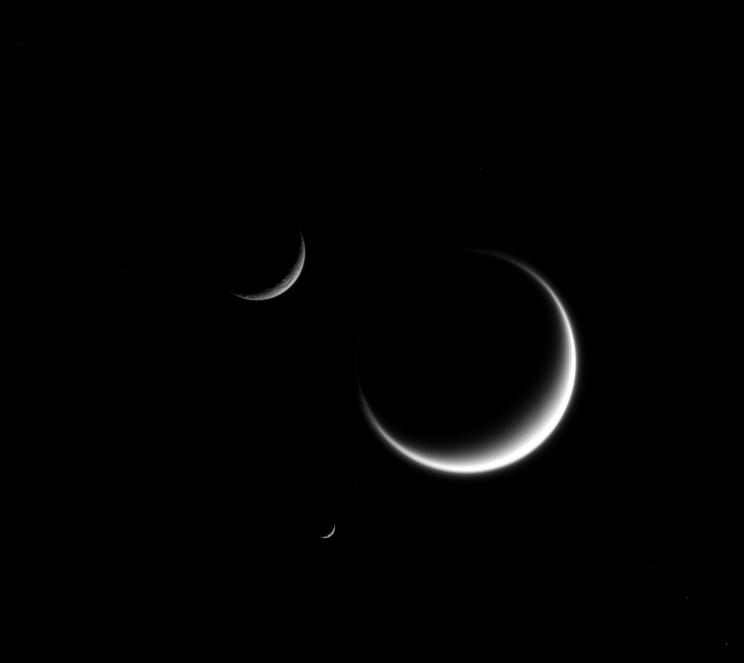
English: PIA18322: Triple Crescents
http://photojournal.jpl.nasa.gov/catalog/PIA18322 This image from NASA's Cassini spacecraft shows three moons -- Titan, Mimas, and Rhea. Titan, the largest moon shown here, appear fuzzy because we only see its cloud layers. A single crescent moon is a familiar sight in Earth's sky, but with Saturn's many moons, you can see three or even more. The three moons shown here -- Titan (3,200 miles or 5,150 kilometers across), Mimas (246 miles or 396 kilometers across), and Rhea (949 miles or 1,527 kilometers across) -- show marked contrasts. Titan, the largest moon in this image, appears fuzzy because we only see its cloud layers. And because Titan's atmosphere refracts light around the moon, its crescent "wraps" just a little further around the moon than it would on an airless body. Rhea (upper left) appears rough because its icy surface is heavily cratered. And a close inspection of Mimas (center bottom), though difficult to see at this scale, shows surface irregularities due to its own violent history. This view looks toward the anti-Saturn hemisphere of Titan. North on Titan is up. The image was taken in visible light with the Cassini spacecraft narrow-angle camera on March 25, 2015. The view was obtained at a distance of approximately 1.2 million miles (2.0 million kilometers) from Titan. Image scale at Titan is 75 miles (121 kilometers) per pixel. Mimas was 1.9 million miles (3.1 million kilometers) away with an image scale of 11.4 miles (18.4 kilometers) per pixel. Rhea was 2.2 million miles (3.5 million kilometers) away with an image scale of 13.1 miles (21.1 kilometer) per pixel. The Cassini mission is a cooperative project of NASA, ESA (the European Space Agency) and the Italian Space Agency. The Jet Propulsion Laboratory, a division of the California Institute of Technology in Pasadena, manages the mission for NASA's Science Mission Directorate, Washington. The Cassini orbiter and its two onboard cameras were designed, developed and assembled at JPL. The imaging operations center is based at the Space Science Institute in Boulder, Colorado. For more information about the Cassini-Huygens mission visit http://saturn.jpl.nasa.gov and http://www.nasa.gov/cassini. The Cassini imaging team homepage is at http://ciclops.org. |
| Tarix | |
| Mənbə | http://photojournal.jpl.nasa.gov/jpeg/PIA18322.jpg |
| Müəllif | NASA/JPL-Caltech/Space Science Institute |
Lisenziya

|
Bu faylın müəllif hüququ sahibi NASA/JPL-Caltech, hər kəsə hər hansı bir məqsəd üçün istifadə etməyə icazə verir, bir şərtlə ki, müəllif hüququ sahibinə düzgün istinad edilsin. Yenidən paylama, törəmə iş, kommersiya məqsədli istifadə və bütün digər istifadələrə icazə verilir. |
|
|
 
|
According to JPL's image use policy additional restriction is that no endorsement of any product or service by Caltech, JPL or NASA is claimed or implied.
Caltech's disclaimer: Caltech makes no representations or warranties with respect to ownership of copyrights in the images, and does not represent others who may claim to be authors or owners of copyright of any of the images, and makes no warranties as to the quality of the images. Caltech shall not be responsible for any loss or expenses resulting from the use of the images, and you release and hold Caltech harmless from all liability arising from such use. Usage on the English Wikipedia: On the English Wikipedia you can use the {{JPL Image}} template to display the copyright notice. (See w:Wikipedia:Using JPL images for details) |
Faylın tarixçəsi
Faylın əvvəlki versiyasını görmək üçün gün/tarix bölməsindəki tarixlərə klikləyin.
| Tarix/Vaxt | Miniatür | Ölçülər | İstifadəçi | Şərh | |
|---|---|---|---|---|---|
| hal-hazırkı | 11:12, 25 iyun 2015 | | 744 × 663 (8 KB) | Drbogdan | User created page with UploadWizard |
Faylın istifadəsi
Aşağıdakı 9 səhifə bu faylı istifadə edir:
Faylın qlobal istifadəsi
Bu fayl aşağıdakı vikilərdə istifadə olunur:
- eu.wikipedia.org layihəsində istifadəsi
- ko.wikipedia.org layihəsində istifadəsi
- zh.wikipedia.org layihəsində istifadəsi
